



Sensex Falls 1,837 Points, Nifty Near 22,500 — Here's What's Actually Going On
 23-Mar-2026
 2 mins read
Trending Now
-

Coal India Shares fell 5% Today — The Government Just announced OFS 27-May-2026
-

Shah Metacorp Rights Issue May 2026 Details, Record Date, Issue Price 26-May-2026
-

Jio Is Going Public. Here's What That Actually Means for You 11-May-2026
-

Parle Products IPO: India’s Most Iconic Biscuit Brand Going Public? 30-Apr-2026
-

SEBI's New Gold & Silver ETF Valuation Rules: What Changes from April 1, 2026? 01-Apr-2026
-
.jpg)
New Tax Rule on Share Buybacks: Will the 12% Surcharge Affect You? 30-Mar-2026
-
Gujarat Cotex Rights Issue 2026 Details, Record Date, Issue Price 27-Mar-2026
-
.jpg)
Avi Polymers Rights Issue 2026 Details, Record Date, Issue Price 11-Feb-2026
-

D & H India Rights Issue 2026 Details, Record Date, Issue Price 05-Feb-2026
-

Avasara Finance Rights Issue 2025 Details, Record Date, Issue Price 29-Dec-2025
-

Vineet Laboratories Rights Issue 2025 Details, Record Date, Issue Price 20-Dec-2025
-

Nacl Industries Rights Issue 2025 Details, Record Date, Issue Price 19-Dec-2025

Sensex Falls 1,837 Points, Nifty Near 22,500 – Market Crash Explained
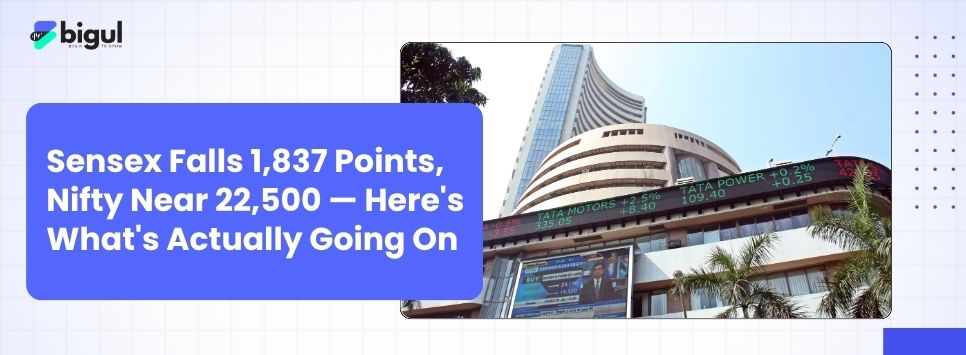
Monday was a rough day for anyone watching their portfolio. The Sensex closed 1,837 points lower at 72,696, and the Nifty 50 dropped 602 points to settle at 22,513 — right around that 22,500 level everyone was keeping an eye on. By end of day, over Rs 14 lakh crore had been wiped off the total market capitalisation of BSE-listed companies, bringing it down to Rs 414.77 lakh crore.
Many Stocks went bleed red out of those Titan and Trent were among the biggest losers, each falling around 6%. UltraTech Cement, BEL, IndiGo, and Tata Steel followed, each losing close to 5%.
So what actually happened? Here's a breakdown.
The Middle East Situation Got Worse Over the Weekend
This is where it all starts. The Iran-US-Israel conflict, now in its fourth week, saw a sharp escalation over the weekend. Trump issued a 48-hour ultimatum to Iran — reopen the Strait of Hormuz completely or face strikes on Iranian power plants. Iran responded by threatening to target energy and water infrastructure across the Gulf.
Markets don't respond well to this kind of uncertainty, and an ongoing conflict involving one of the world's most critical oil chokepoints keeps investors on edge.
Oil at $113 — And That's a Big Problem for India Specifically
Brent crude reached $113 per barrel on Monday. The Strait of Hormuz — the route through which over 20% of global oil supply moves — remains disrupted. Iran has now threatened to close it "indefinitely" if the US follows through on its threats.
For India, which imports the majority of its crude oil, this isn't just a headline. Higher oil prices directly raise the import bill, add to inflation, and squeeze government finances. Every dollar rise in crude hits India harder than most other major economies.
Rupee at a Fresh All-Time Low
The rupee crossed 94 against the US dollar on Monday, going past its previous record of 93.7350 set just on Friday. It has now weakened nearly 3% since the Middle East conflict began.
The connection is fairly direct — higher oil prices mean India needs more dollars to pay for imports, which puts pressure on the rupee. Analysts at LKP Securities expect the currency to remain in the 93.00–94.25 range in the near term, unless crude prices come off meaningfully.
Foreign Investors Have Been Selling for 16 Sessions Straight
FIIs net sold Indian equities worth Rs 5,518 crore on Friday alone, extending their selling to 16 consecutive sessions. Sustained outflows at this scale keep sentiment weak and make it harder for markets to find stable ground.
Global Markets Were Already Under Pressure
This wasn't just an India story. South Korea's Kospi fell 7%. Japan's Nikkei lost nearly 4%. Hong Kong's Hang Seng was down 3.6%. On Friday, Wall Street had already closed on a weak note — Nasdaq down over 2%, S&P 500 down over 1.5%. European markets followed on Monday, with Germany, France, and the UK each seeing losses of nearly 2%.
When global sentiment turns this cautious, Indian markets rarely stay unaffected.
Industrial Diesel Prices Hiked 25% Domestically
Adding to the pressure on the domestic front, state-run oil marketing companies raised industrial diesel prices by 25% — around Rs 22 per litre — on Friday. Retail diesel prices remain unchanged for now, but sectors like railways, mining, construction, manufacturing, and telecom infrastructure will feel the impact. According to Nomura, industrial diesel accounts for around 13% of total diesel consumption in India.
Where Do Things Go from Here?
A lot depends on how the Middle East situation develops. If tensions ease and oil prices cool down, markets could stabilise. But if the conflict continues or the Strait of Hormuz stays disrupted, pressure on crude prices, the rupee, and Indian markets could persist.
The Nifty has already moved below key support levels, with analysts now watching the 22,700–22,400 zone. On the upside, 23,862 is the level that needs to be crossed before any talk of a recovery makes sense.
All figures and data in this post are drawn from publicly available market and news sources. This is purely an informational post and should not be read as investment advice.